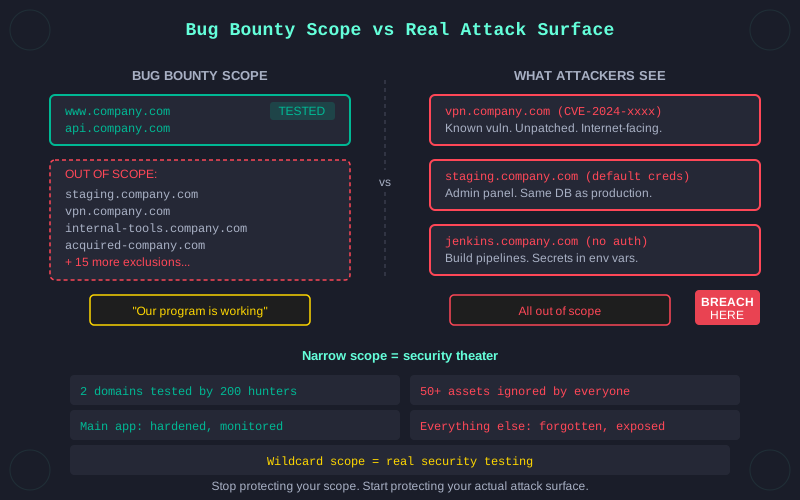
Your bug bounty program is protecting you from findings, not from attackers.
Attackers don't have a scope. No rules of engagement. No "these IPs are out of scope." No "only test the web application." They look at everything. Subdomains, acquisitions, third-party integrations, employee accounts, that forgotten VPN nobody monitors. Everything is fair game.
Now look at how most bug bounty programs work.
Limited domains. Long exclusion lists. "Do not test" on half the infrastructure. The things that get tested are secure. The things that don't are where breaches happen.
I've seen this play out more times than I can count. A company launches a bug bounty program with a tight scope: two domains, one API, and a list of exclusions longer than the actual target list. Hunters hammer those two domains, find some medium-severity stuff, and the security team feels good. "Our bug bounty program is working."
Meanwhile, the staging environment from 2021 is still running with default credentials. The internal tool that HR uses has a SQL injection nobody ever looked at. The acquired company from last year still has its own infrastructure, completely untested, connected to the same network.
That's not security. That's security theater.
The attacker who eventually breaches that company won't care about the bug bounty scope. They'll find the VPN with the known CVE. They'll phish an employee and pivot from there. They'll discover the forgotten subdomain running Jenkins with no authentication. The scope document means nothing to them.
That's why I always go for company-wide and wildcard scopes. They let you operate closer to how a real attacker would. No artificial limits. Full surface. When a program says *.company.com, I can actually test the things that matter instead of fighting over the same five endpoints with 200 other hunters.
And that's where recon becomes everything.
When the scope is wide, you can't just run a scanner and start clicking around. You need a process. Deep subdomain enumeration. Fingerprinting. Identifying forgotten assets, staging environments, legacy systems. Mapping what the company doesn't even know is exposed.
That's what I try to do with my recon automation. Go wide, go deep, find what nobody is looking at.
The process looks something like this:
- Subdomain enumeration across multiple sources, not just one tool
- Port scanning on discovered hosts to find services running on non-standard ports
- Fingerprinting technologies to identify outdated or vulnerable stacks
- Crawling for exposed panels, login pages and admin interfaces
- Checking for default credentials on anything that looks forgotten
- Correlating acquired companies and their infrastructure with the parent
Most of this runs automatically. The manual work comes after, when I look at the results and pick the targets that look neglected. Those are the ones where critical findings live.
I've found RCEs on staging servers that mirrored production. I've found full database access through internal tools that were never meant to be public. I've found admin panels with no authentication on subdomains the company didn't know existed.
None of that was on the main app.
If you're a hunter, stop limiting yourself to the obvious targets. If a program offers a wildcard scope, use it. If they don't, look for programs that do. The competition is lower, the findings are better, and the payouts are higher.
If you're a company, challenge yourself. Look at your bug bounty scope and ask: "Does this reflect what an attacker would actually target?" If the answer is no, you're not running a security program. You're running a compliance checkbox.
Stop protecting your scope. Start protecting your actual attack surface.
